

Introduction
Successful marketing requires a lot of work. You need to hire the right talent, find the right audience, have the proper budget, and put it all together in an effective strategy. There’s a lot to balance out in carrying out an effective marketing campaign.
The most crucial component of a marketing campaign is your audience. Without a clearly defined customer persona, your marketing campaigns will not yield great results. A B2C (business to consumer) focused sales process is vastly different from a B2B (business to business) process. In a B2B deal, you sell to businesses and may have to deal with multiple decision-makers. The ticket sizes will be much higher and the sales cycle would go on for much longer.
In this article, we discuss B2B leads – who they are, how they differ from B2C leads, and also talk about different strategies for B2B sales.
What are Sales Leads?
Sales leads are people or businesses who may ultimately become paying clients. The information cards of potential clients are also sometimes referred to as leads. Through marketing efforts, companies gain sales leads, but not all sales leads are ready to convert. You’ll still need to run them through some systems to qualify them as purchase-ready. Some leads still need to be nurtured to build them up to a point where they’re ready to make a purchase.
Characteristic differences of B2B and B2C leads:
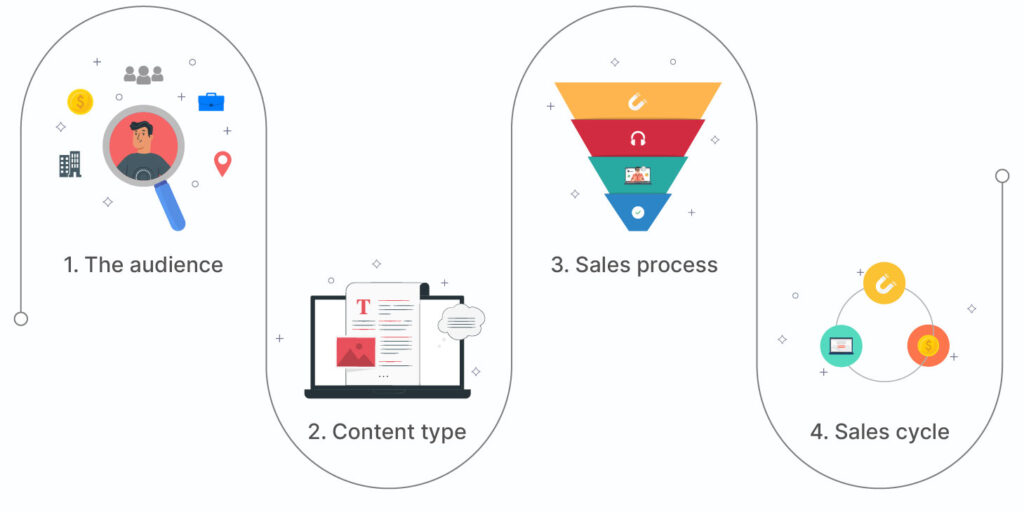
There are major differences in how B2B sales and B2C sales happen. It’s essential to keep some of these differences in mind while contemplating a solid B2B lead generation approach.
- The audience – For B2C leads generation, the target audience is much broader; therefore, successful campaigns are gauged by how well they can attract the audience’s attention. The decision to make a purchase rests solely on the individual. Whereas, in B2B lead generation, the target audience is narrow. Successful campaigns must be highly personalized and precise, ensuring that the products and services reach business decision-makers.
- Content-type – B2C leads arguably require less technical information. Moving them along the sales funnel is mostly about well-timed promotions, offers, and personalized messaging. In contrast, B2B leads are savvier and tend to do more thorough research before committing to a purchase. Since different decision-makers are involved, different types of content pieces need to be generated for them. Since B2B clients require more information, the trick is to recognize their needs at every stage of the buyer’s journey, using case studies, white papers, and email sequences to move them along the journey.
- Sales process – B2C leads make purchase decisions based on their perception of the product or service. They usually don’t need to know anyone at a company before they make a decision. B2C leads make purchases on impulse and are more susceptible to price tricks and gimmicks. B2B leads, on the other hand, usually spend time getting to know representatives at a given company before purchasing. They like to build trust with company representatives over time and only feel comfortable making payments when they’ve created a professional relationship with company reps. Since the stakes are usually higher in B2B sales, purely impulse decisions are rarely made.
- Sales cycle – The time and resources devoted to closing deals with B2C leads are less significant when compared to that of B2B leads. B2C transactions take less time and typically involve way less money, While B2B transactions take a long time frame, with contracts taking months or even years to finalize.